A record of consultations.
In the source introduction, the author describes studying Jyotish since 1992 and documenting events shared during consultations. Some people contributed only one or two events; others contributed several.
The application preserves the distinction between an observation and a person. It does not infer shared case identities, calculate probabilities, or treat a repeated event as a guaranteed outcome.
The Moon is the starting point.
The system focuses on Chandra—the Moon—and its Janma Nakshatra, the constellation occupied at birth. The 27 nakshatras are currently organized into nine groups by ruling planet.
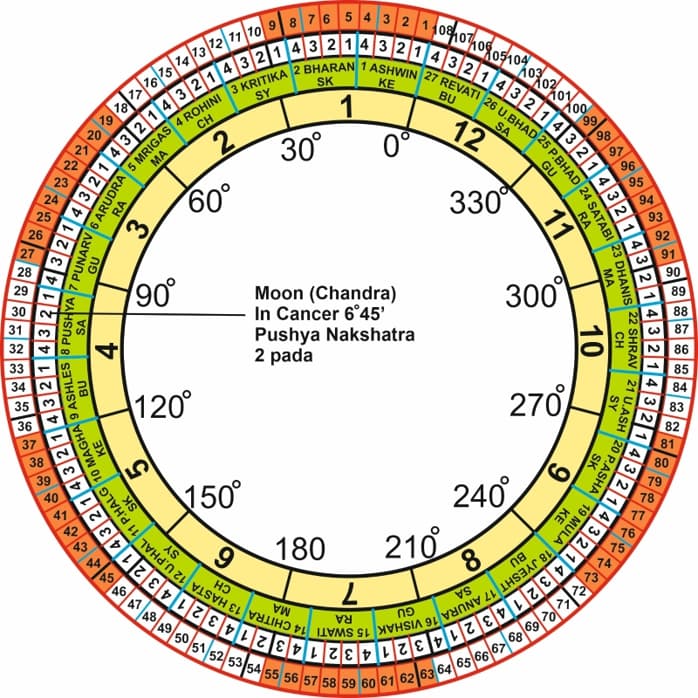
The database also allows observations to be associated with an individual nakshatra as the research develops. Current group-level records must not be mistaken for research specific to just one constellation.
Three nested periods.
Vimshottari identifies a main planetary period (Mahadasha), a subperiod (Antardasha), and a third level (Pratyantardasha). The records distinguish the sequence at birth from the sequence when an event occurred.
Automatic calculations must be validated against the author’s preferred Parashara’s Light configuration. Ayanamsha, year length, historical timezones and daylight saving must be confirmed. Until then, manual input uses the values from your existing chart.
What the archive can—and cannot—say.
- The database is incomplete. Some combinations have no observations.
- Source ages have different precision. Missing days stay unknown.
- Matching observations are historical records, not guaranteed future events.
- Counts of observations do not establish probabilities or scientific validation.
- Ambiguous period codes, contradictory headings and suspected duplicates are held for review.
- Life-area categories are browsing aids. Record details always show the original event wording.
Read the author’s original introduction
The text below preserves the author’s words and claims. It is distinct from the application’s interpretation of the dataset. Research tables and reference images are presented separately.
Edition – Life periods
Rhythms of Time
Jyotish VEDIC
astrologyVimshotari dasha
(Moon based)
(Statistics, Database, Tables / Spreadsheets)
ver.1.2
By Ignac Peras
How to Use This Book
I began my journey through Jyotish astrology in 1992. Since then, I have been providing consultations and teaching Jyotish courses.
Throughout all these years, I have documented the events and experiences of the thousands of people who came to me for Jyotish consultations. As a result, I have compiled a database containing thousands of individuals and their life events.
This book is a statistical compilation—data from thousands of people and their documented events organized into structured tables.
Instructions
To use this book, you will need: Date, place, and time of birth (the more precise the time, the better). If you do not know your exact time of birth, this book is not for you.
This data needs to be entered into a Jyotish software program. As a reference point, I use the Jyotish software Parashara’s Light, but you can use any other software of your choice. You need to enter your details: place, date, and time of birth. The program will calculate and draw your birth chart (natal chart).
Next, look at where your Moon is positioned in that birth chart. In some software programs it may be listed as Chandra instead of Moon. The abbreviations used might be CH or MO (Chandra, Moon). Ignore the other planets.
It is standard in Jyotish software programs to display the exact degree of the wheel of zodiac where the Moon is located, followed by the zodiac sign and the nakshatra (constellation). Additionally, the active Vimshottari dasha period is usually shown.
Example 1: A person was born when the Moon (Mo) was in Leo at 8°09’47” (8 degrees, 9 minutes, and 47 seconds), in the nakshatra Magha, during the Vimshottari period KE-JU-ME (Ketu-Jupiter-Mercury).
Look up the page in this book where the nakshatra group (Ashwini, Mula, Magha) is listed.
Read the events that happened to people who have such a combination, that is, those who were born in the same Nakshatra group.
Events
All Vimshottari periods info refer to the beginning of an event. For example, the onset of an illness, starting a job, etc. Sometimes it marks the end of an event (for example, finishing school, graduation).
This means the person was born in the Ketu nakshatra group (Ashwini, Mula, Magha).The birth period is KE-JU (Ketu – Jupiter):
We can see that people in the Moon period experience quite a few problems, especially during the Moon – Rahu period (MO-RA).
For people whose birth nakshatra period is Ketu – Jupiter – Saturn (KE-JU-SA) - during the Venus – Mercury – Saturn period (VE-ME-SA) we have an example of two different people who had a child born to them almost on the exact same day, that is, when the first one was 21 years and 3 months old, and the other one was 21 years and 5 months old. A second child may be born when the person is approximately 26 years and 2 months old, or 28 years and 2 months old, during the Sun – Saturn – Rahu period (SU-SA-RA).
As we can see, the Venus – Mercury period (VE-ME) is generally good for the birth of a child, marriage, employment, etc.
This is not set in stone. You can also have children at other times. Here are only the statistical data from the people I have in my database. For now, it is not a large amount, but over time I will be adding more events and people.
From some people I have recorded only one or two events—for example, I only know the date when their child was born and that is all. From others, I have records of about ten events. Some combinations of Vimshottari periods are empty; here, in this current example, we only have 4 planets at the third level (3rd sub-period / bhukti), which are:
KE-GU-RA, KE-GU-VE, KE-GU-SA, KE-GU-MO.
The remaining combinations are missing:KE-GU-KE, KE-GU-SU, KE-GU-MA, KE-GU-JU
Over time, I will fill in the missing gaps. For that, I need a larger database. If you are a Jyotish astrologer and have your own database, I would be happy if you could share it with me. You can write to me at the email address:
ignacperas@gmail.com
This book is not finished. It will be updated little by little. Right now, this is version 1.0 of the book. There will be version 1.1, and so on. Every couple of months, I will add new event data. Over time, there will be more and more events, so the accuracy of the event predictions will increase. This is the reason it is sold on Amazon in electronic format.
Once again, I emphasize that this is merely a collection of statistical data from people who have had a Jyotish consultation. The more a certain pattern repeats, the higher the probability of the event’s accuracy.
You can use this book without any knowledge of Jyotish, regardless of whether you are studying Jyotish or are a master of Jyotish. The written combinations in this book apply to all people in the world. Enjoy!
Jyotish AstrologyTheory and Practice
Some people do not want to know the future. They do not want to know what will happen tomorrow. However, I believe that it is good to know a person’s destiny.
Yesterday I listened to the weather forecast. The forecast was that tomorrow there would be a storm, snow, and cold weather. Below zero degrees. Is that a good thing to know? If you are wise, you will prepare for that day and dress warmly. Those who did not listen to the news will be caught by surprise. And that day will pass as well. Sometimes beautiful weather awaits us. That is also good to know, so we can make the most of it. And that day will pass too. It is good to know what lies ahead in the future so that we can act accordingly.
In order to “see” destiny, we need to have the appropriate tool and knowledge that enables us to do so.
My search for that knowledge which allows us to “see destiny” began back in 1992. Since then, I have been studying Jyotish and other predictive techniques. I teach myself and others, conduct consultations, and hold courses (in Croatia - Europe). I have also studied other systems of divination and destiny analysis, such as: BaZi (Chinese astrology), Zi Wei Dou Shu (Chinese astrology), Mayan calendar, Numerology (multiple systems), Nadi astrology (South Indian astrology), Western astrology, 9 Star Ki (Japanese astrology), Mahabote (Burmese astrology), Palm leaf manuscripts (Tamil Nadu)...
All these systems I have listed are logical and mathematical; combinatorics is required to perceive destiny. Common sense and a specialized logic are needed. These listed systems do not rely on intuition. There are other systems based on intuition, channeling, and similar methods: tarot, crystal ball, cowrie shells, I Ching, clairvoyance, telepathy, precognition, etc.
Of all these systems, for me personally Jyotish astrology has proven to be the most accurate one. When I mention the word Jyotish, it refers to the book Hora Shastra, attributed to Maharishi Parashara. In this system, the exact time of birth is extremely important. A difference of just an hour or a minute shifts the date of an event by several days or even months.
Logic
Jyotish means light. A lamp, a flashlight that illuminates the path ahead of us so we do not fall into a pit. In front of you there is future, behind you there is the past. Where you stand right now is the present. Jyotish is logical. Most often, predictions are made using logic.
For example: the Sun–Rahu period is interpreted as problems connected with the father or the father having problems. That is a logical interpretation. All astrologers use it.
There is another type of interpretation based on a large number of recorded events. When you have a vast number of events, you can draw your own conclusions and categorize events according to specific periods. That is what is presented here in this book. If you want to make conclusions in this way, you need to conduct several thousand consultations and log every single event. To prove that this system works, you must possess a large database with statistical data.
This book is my original work. Anyone can use this book, even without prior knowledge of Jyotish astrology. Jyotish masters (those with years of knowledge and practice) will be able to utilize my simple sentences with even greater precision. They can interpret them in relation to a person’s Rashi chart.
For example: The SATURN–RAHU period brings various problems. The person will certainly experience difficulties, but their severity depends on where Saturn and Rahu are placed in the Rashi chart. If they are placed in the 11th house, the issues for the individual will be minor. If they are placed in the 8th house, there will be major problems. In this way, a person can prepare by observing themselves and events happening around them. As soon as they notice something unusual, they should take action immediately to mitigate challenging periods like this one (SA-RA). How?
By applying knowledge from Vastu, Ayurveda, mantras, yagyas, pranayamas, Hatha Yoga, etc. (Regarding Vastu architecture, you can refer to my book – Vastu)
a Bit of Math and Calculation
When you meet a friend or get to know someone new, you often ask them what their horoscope sign is. And that person responds that they are a Leo, Aquarius, Aries, etc. What does that actually refer to? What is it, really?It refers to the zodiac, which has 12 signs and spans 360 arc (circular) degrees. Each sign is 30 arc degrees. If you multiply that by 12, you get 360 arc degrees. Looking from planet Earth towards the sky, we can discern these zodiac signs.
The Roughest Division into 12 Zodiac Signs
Planets move around constantly. In this way, we can see which zodiac sign the Sun occupies at any given moment. If, for example, the Sun is currently in the sign of Aries and a baby is born, that person will grow up telling everyone that they are an Aries. In reality, that is a very, very rough division of the Zodiac circle into 12 signs. It is like dividing 8 billion people into 12 groups and searching for what every single group has in common.
This is what certain “scientists” do when they want to prove that astrology doesn’t work. And that is how astrology gained a bad reputation as charlatanism—because people have always focused on the roughest division into 12 parts.
Division into 27 Parts (Nakshatras)
If we were to divide the 360-degree circle into 27 parts instead of 12, each section of that zodiac would span thirteen degrees and twenty minutes (13°20’00”). In Jyotish, this division parts are called Nakshatras (constellation). Here, we divide 8 billion people into 27 parts. That is a slightly better division than 12 parts.
Division into 108 Parts
Each Nakshatra has 4 padas, or subdivisions into 4 parts. Each part spans three degrees and twenty minutes (3°20’00”) of the zodiac arc. Thus, we get 108 parts of the zodiac circle. That would mean dividing all the people in the world into 108 groups. That is already better.
Division into 360 Parts
However, Jyotish goes further (remember, a circle has 360 arc degrees), which means dividing humanity into 360 groups. That is an even more precise division of all people in the world.
Division into Numerous Parts
Each degree of that circle consists of 60 arc minutes, which means 360 x 60 = 21,600 groups of people. Each minute consists of 60 arc seconds, which means 21,600 x 60 = 1,296,000 groups of people.A division into 1,296,000 parts is certainly better than the 12 parts found in daily newspapers, which skeptics often reference.
That number is for just one single planet. For instance, the Moon can be placed in 1,296,000 possible positions. In Jyotish, we have 9 planets. Therefore, everything is multiplied by 9. That way, we get an immensely large number of combinations. These combinations do not apply only to humans. They also apply to animals—more precisely, to anything that has a beginning in this world. To everything that has entered this universe we inhabit and that surrounds us (the matrix).
When you meet someone and want to introduce yourself, it is not entirely accurate to say “My Sun is in Leo,” but rather “My Sun is at 10 degrees, 25 minutes, and 45 seconds of Leo.” You can also add that your Sun is in the Nakshatra Magha. In this book, each nakshatra is divided into 100 parts. That is my current capacity.
There could be an even finer division into 1,000 parts, but for something like that, one would need a database of at least 100,000 people and 1,000,000 events. I am leaving that task to younger generations.
12 zodiac signs, 27 Nakshatras, 108 padas (ili 108 padas / subdivisions)
Let us take, for example, the zodiac sign Sagittarius. If we take 100 people who have the Moon placed in that zodiac sign (if all of them are within those 30 degrees), each of them will have a different destiny. However, if we take people who were born at the exact same degree of that zodiac sign - for instance, people who have the Moon at 20 degrees of Sagittarius - many of them will share similar traits and experience similar events in their lives. If it is precise down to the minute, or even better, down to the second of the zodiac sign Sagittarius, you would be amazed at how many similar events occurred during the exact same period in those individuals’ lives (at the same age).This book is built upon that very paradigm.
Moon (Chandra)
In this system of Jyotish, everything is based on the planet Moon, which is called Chandra in Sanskrit. In Jyotish astrology, the Sun (ego) is not the most important planet; rather, it is the Moon (mind, emotions). The Western world is based on the Sun, whereas the Eastern world is based on the Moon. Thus, the Moon is the most important planet in Jyotish. And the system presented in this book is based on your Moon. The technical term is Janma Nakshatra (the Nakshatra in which the Moon is located). There are 27 of these Nakshatras.
Below is the division of the 27 Nakshatras into 9 groups.
Each group has the same starting point, because it is ruled by the same planet. A division into 27 Nakshatras would be more precise, but currently, in my data base I do not have a sufficient number of people and their events.In the future, I will do this—dividing it into 27 parts rather than 9.
Periods
I mentioned sage Parashara, who, in his book Hora Shastra, among other things, talks about Vimshottari Dasha. What is that?
Translation from Sanskrit: Vimshottari – 120, Dasha – period. Therefore, a period of 120 years. Maharishi Parashara stated that a human being should live that long (with exceptions for those who live longer). Today, all astrologers use the Vimshottari system. Sometimes a Vimshottari period does not seem logical for a certain event. For example, Jupiter-Venus-Mercury. That is a very good period. Yet, in the table, it says: injuries and accidents, surgeries, etc.Although Vimshottari is the most precise period system, there are other types of periods in Jyotish that overlap and can be very unfavorable, such as Ashtottari, Kalachakra, etc.
Each period system has a different lifespan/duration, which I will not explain in this book. There are additional systems within Jyotish, such as Transits (Gochar), Varshaphala, and Tithi Pravesha (annual horoscopes).Perhaps one day I will write books covering all these Jyotish systems.
The image below shows all the Dasha period systems included in the Parashara’s Light software:
Acknowledgments
I would like to take this opportunity to thank my students, who also helped me with their charts in the creation of this book. Likewise, I thank all the people who have come to me for a Jyotish consultation over the last 35 years. Without them, I would not have been able to write this book.
Meaning